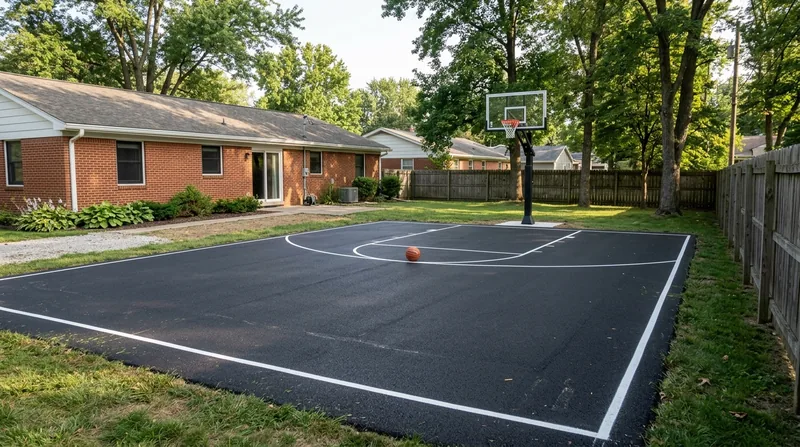




A backyard basketball or tennis court in Lafayette takes real punishment from central Indiana winters. The freeze-thaw cycle that runs October through April heaves the glacial till subgrade underneath, and any court built on a thin or poorly compacted base will crack, settle, and shed aggregate within a season. Sports court and path paving in Lafayette means building a deep, properly graded foundation first, then finishing with hot mix asphalt that stays flat and playable through Tippecanoe County's wet springs and hard freezes. We grade and compact the base, manage drainage so water doesn't pool under the slab, and lay asphalt thick enough to handle years of dribbling, running, and seasonal heave. The result is a court that plays true and holds up to the local climate.
Why Proper Base Preparation Matters for Courts in Lafayette
Most court failures in this region start below the surface. The till plain soil that underlies Lafayette, West Lafayette, and the surrounding county won't drain on its own, and when water sits in the subgrade through winter, frost heave lifts the asphalt slab unevenly. A court built without a compacted stone base or with inadequate grading will show alligator cracking and surface settlement within two to three years. The cost to repair a failed court base is much higher than the cost to build it right the first time.
- We excavate and remove unsuitable topsoil down to stable subgrade, exposing the till that will carry the load.
- We install and proof-roll a compacted base course of crushed stone, typically four to six inches depending on soil conditions and court size.
- We grade the base to slope gently for drainage, so meltwater and rain run off and do not pool under the asphalt.
- We lay hot mix asphalt in two lifts, compacting each to achieve density and durability through seasonal temperature swings.
A properly built court base will perform for fifteen to twenty years before resurfacing becomes necessary. Skipping or shortcutting base work is the single most common reason courts fail early in Lafayette's climate.
Key info: Lafayette's freeze-thaw cycle runs October through April. A court built on an inadequate base will heave and crack within the first winter. Proper grading and a compacted four to six inch stone base are not optional in this climate.
For more detail on how we prepare surfaces in this region, see our gravel driveway installation and grading page, which covers the same base-preparation techniques we apply to courts and paths.
How We Build a Court or Path That Stays Flat Through Lafayette Winters
The process starts with a site visit and measurement. We assess soil conditions, drainage patterns, and the intended use of the court or path. From there, we develop a grading and base plan tailored to your property and Lafayette's climate. Most residential courts in this area need a four to six inch compacted base; larger or heavily trafficked paths may need more. We then lay asphalt in two lifts, compacting as we go, and finish with a smooth, even surface ready for play.
- We measure the court or path area and mark out the work zone, respecting property lines and any existing structures.
- We excavate unsuitable material and grade the subgrade level, sloping gently for drainage away from structures.
- We bring in and spread crushed stone base material, compacting it in lifts to achieve proper density.
- We proof-roll the base with a heavy vehicle to confirm it is solid and will not move under the weight of play or seasonal frost.
- We lay the first lift of hot mix asphalt, typically one and one-half to two inches, and compact it fully.
- We lay the final wearing course, compact it, and finish with a smooth, level surface ready for line marking or play.
The entire process typically takes three to five working days for a standard residential court, depending on size and weather. We coordinate with you on scheduling and site access.
Example: A homeowner in Lafayette wanted a half-court basketball area in the backyard. The site sat on a slope with poor drainage toward the house. We graded the area, installed a six inch compacted base with proper slope, and laid three and one-half inches of asphalt. The court has now played true for four seasons through multiple freeze-thaw cycles. A thinner base or poor grading would have failed within the first winter.
If you also need driveway or parking area work, we handle asphalt driveway paving and installation with the same attention to base and drainage.
Sports Court and Path Paving Methods in Lafayette
| Approach | Description | Best for |
|---|---|---|
| Full-depth court paving | Excavate unsuitable soil, install compacted stone base four to six inches, lay two lifts of hot mix asphalt totaling three and one-half to four inches. | New courts, failed bases, or sites with poor drainage or soft subgrade. |
| Path resurfacing over existing base | Grind or mill the old surface, inspect the base, add stone if needed, then lay new asphalt in two lifts. | Existing paths with sound bases and minor cracking or surface wear. |
| Overlay on existing court | Clean and prepare the existing surface, lay one and one-half to two inches of new asphalt over the old base. | Courts with solid bases and light to moderate cracking, where base replacement is not needed. |
| Gravel or recycled millings path | Grade and compact the subgrade, install recycled asphalt millings or crushed gravel, tamp and level. | Walking paths, secondary courts, or budget-conscious projects where asphalt is not required. |
Each method is chosen based on the existing condition of the site, the intended use, and your budget. We assess the court or path in person and recommend the approach that will last longest and perform best in Lafayette's climate.
Sports Court and Path Paving Cost in Lafayette: What to Expect
The cost of a new court or path depends on size, soil conditions, base requirements, and the asphalt thickness you choose. A standard residential basketball court or tennis court in Lafayette typically starts at $8,500 and can range higher depending on excavation, base depth, and site access. A shorter walking path may cost less; a larger or heavily trafficked area may cost more.
Factors that move the price up or down: Courts on poor drainage sites need deeper base work. Courts on steep slopes require more grading. Sites with limited access for equipment may require hand labor or smaller machinery, which increases cost. The asphalt thickness you choose also matters; a court built for heavy play may use four inches of asphalt, while a light-use path may use three inches.
We always provide a written estimate with tonnage and thickness specifications so you know exactly what you are paying for. The estimate includes site grading, base material, asphalt, compaction, and labor. We do not charge for the estimate, and there is no obligation to book. Call us at (765) 523-8939 or visit our pricing page for more detail on how we quote sports court and path work.
Getting two or three estimates from local contractors is smart. Compare the base depth, asphalt thickness, and compaction method, not just the total price. A contractor quoting significantly less than others may be cutting corners on base preparation, which is where failures start.
What to Look for When Hiring a Sports Court Paving Contractor Near Me in Lafayette
Hiring a contractor for court or path paving is a significant decision. The work is visible, it affects how the court plays, and a poor job will cost you money to fix. Start by asking any contractor you interview for references from recent court or path jobs in Lafayette or the surrounding area. Call those references and ask how the court has performed through winter, whether it has cracked or settled, and whether they would hire the same contractor again.
Key things to verify: Confirm the contractor is fully insured and can provide a certificate of insurance before work begins. Get a written estimate that specifies the base depth, asphalt thickness, compaction method, and total tonnage of material. Do not accept a verbal quote or an estimate without tonnage. Ask about permits; depending on your property location and whether the court is in an HOA, you may need approval from the local building department or homeowners association. Verify that the contractor will handle or coordinate any required utility locates through Indiana 811 before excavation begins. Finally, ask about the warranty on workmanship; an honest contractor will offer one to three years on installation quality, not a lifetime guarantee.
We are fully insured, and we provide written estimates with tonnage and thickness on every job. We help you navigate local permitting and coordinate utility locates. Call us at (765) 523-8939 to schedule a free estimate, or visit our contact page to request one online. We respond within 24 hours and serve Lafayette, West Lafayette, Dayton, and the surrounding Tippecanoe County area.
Sports Court & Path Paving in Lafayette: Pricing Guide
| Service | Price | Details |
|---|---|---|
| Residential basketball or tennis court (full-depth) | Starting at $8,500 | Includes excavation, four to six inch compacted base, two lifts of hot mix asphalt, proper grading and drainage for Lafayette climate |
| Walking or recreational path (full-depth) | Starting at $6,000 | Smaller footprint, similar base and asphalt methods, sized for pedestrian or light recreational use rather than intensive court play |
| Court overlay on existing base | Starting at $4,500 | Existing base is sound, no excavation needed, surface prep and new asphalt wearing course only, fastest option if base is solid |
| Recycled millings or gravel path | Starting at $2,500 | Budget-friendly walking path, compacted recycled asphalt or crushed gravel, no hot mix required, good for secondary or informal use |
| Site visit and written estimate | Free | Response within 24 hours at (765) 523-8939, includes measurement, soil assessment, base recommendation, and tonnage specifications |
Indicative pricing, the exact cost depends on square footage, finish, and site access. Free personalized estimate within 24h at (765) 523-8939.


