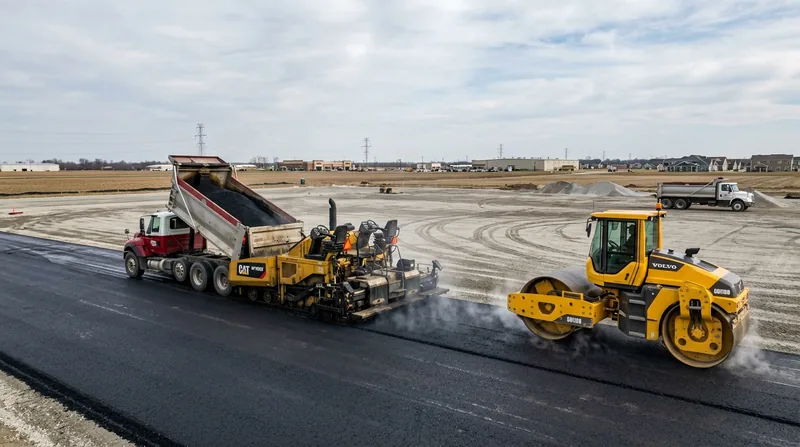




Parking Lot Paving & Construction in Lafayette demands a foundation built for the freeze-thaw cycle that dominates central Indiana winters. Lafayette sits on glacial till subgrade that holds water and won't drain on its own, and the Wabash River valley's clay-rich soil heaves under frost every year. Commercial lots across Tippecanoe County need a thick, properly compacted base to handle heavy vehicles and the seasonal stress that breaks asphalt from underneath. We grade and compact a deep aggregate base, then pave in binder and surface courses sized for growing subdivision traffic and the weight they carry. Whether you're building a new lot for a retail strip, a warehouse complex, or a multi-tenant commercial property, the base work determines how long your pavement lasts and how much you'll spend repairing it later.
Why Parking Lot Paving & Construction Matters in Lafayette: The Frost-Heave Problem
Central Indiana's winter works on thin or poorly compacted bases every year. Freeze-thaw cycles open cracks in the asphalt surface, water penetrates to the base, and the next winter's frost heaves the pavement up and apart. A lot built on a shallow base or subgrade that wasn't properly prepared will fail in three to five years, not fifteen. A commercial lot that takes heavy delivery trucks, service vehicles, and daily traffic needs a base deep enough to distribute that load and keep water from pooling underneath. Many older lots in Lafayette, West Lafayette, and Dayton were paved over minimal base preparation, and they're showing it now with alligator cracking and surface failure that extends into the base itself.
- We excavate and remove failed asphalt and subgrade material down to stable soil.
- We grade and compact a deep aggregate base, typically four to six inches or more depending on traffic load and soil conditions.
- We proof-roll the base to verify compaction and bearing capacity before any asphalt goes down.
- We pave in a binder course and surface course, sized for the vehicle weight and frequency your lot will see.
- We set proper drainage slopes so water runs to storm drains and doesn't pond on the surface or underneath.
A lot built this way will hold up through the seasonal stress that destroys quick-and-cheap jobs, and you'll get fifteen to twenty years of service before major resurfacing is needed.
Key info: Many commercial lots in Lafayette and surrounding areas fail prematurely because the original base was never compacted properly or was skipped entirely. When frost heaves that base, the asphalt cracks from below, and patches don't hold. Proper base preparation costs more upfront but saves thousands in premature repairs.
Check with your local building department to understand permit requirements for your lot. Lafayette's municipal standards and West Lafayette's rules both govern impervious surfaces, stormwater drainage, and curb cuts. We help you navigate those requirements and ensure your lot meets code.
How We Build a Commercial Parking Lot in Lafayette: The Process from Grade to Finish
A parking lot is not a driveway, and the construction sequence reflects that. Commercial traffic is heavier, the surface takes more abuse, and the base must be engineered to handle it. We start with a site survey and existing-condition assessment, then move through excavation, base preparation, proof rolling, and paving in a sequence that builds strength from the ground up. Every step is documented with tonnage specs and measurements so you know exactly what you're getting.
- We measure the lot, identify drainage patterns, and plan the base profile for your specific traffic load.
- We remove existing asphalt and subgrade material that's failed, or grade and prepare virgin soil.
- We deliver and compact aggregate base in lifts, checking compaction density with proof rolling.
- We verify drainage slopes and address any soft spots or areas where water would pond.
- We pave the binder course, then the wearing surface, in accordance with your lot's design and traffic volume.
- We stripe and finish per your specifications and local code.
The entire process typically takes one to three weeks depending on lot size, weather, and base conditions. We work around your business hours and coordinate access so your tenants or customers stay mobile.
Example: A retail strip in Battle Ground needed a new lot after ten years of pothole patching on a base that was never compacted. We excavated six inches of failed asphalt and subgrade, brought in four inches of compacted stone base, proof-rolled it, and paved a two-inch binder and one-inch surface course. The lot now handles delivery trucks and daily traffic without cracking or ponding, and the owner expects fifteen-plus years of service.
If your lot is showing widespread alligator cracking, we can also discuss asphalt resurfacing and overlay as a lower-cost alternative if the base is still sound. A site visit tells us whether your lot needs full reconstruction or a mill-and-overlay approach.
Parking Lot Paving Methods and Approaches
| Approach | Description | Best for |
|---|---|---|
| Full-Depth Replacement | Remove all failed asphalt and subgrade, compact new base, pave new binder and surface courses. | Lots with extensive alligator cracking, base failure, or poor drainage that cannot be salvaged by overlay. |
| Mill and Overlay | Mill off the top one to two inches of worn asphalt, inspect the base, then pave a new wearing surface. | Lots with surface wear and minor cracking but a sound, compacted base underneath. |
| Patching and Spot Repair | Excavate and fill individual potholes or failed sections with hot-mix asphalt, compacted in place. | Lots with isolated potholes or small failed areas in an otherwise sound pavement. |
| Full Reconstruction with Grading | Excavate and grade the entire site for proper drainage, build new base and subbase, then pave. | New construction, lots with severe drainage problems, or sites where water ponds or undermines the base. |
Parking Lot Paving & Construction Cost in Lafayette: What to Expect
Parking lot costs in Lafayette start with a free commercial estimate that includes measurements, soil assessment, and a detailed quote with tonnage and course specifications. Full-depth replacement typically ranges from $3 to $6 per square foot depending on base depth, soil conditions, and traffic load. A mill-and-overlay on a sound base runs $1.50 to $3 per square foot. Spot patching costs less per square foot but becomes uneconomical once thirty to forty percent of the lot has failed. The single biggest cost factor is base preparation: if your subgrade needs excavation, grading, and compaction, that work costs money upfront but prevents expensive failure later. A lot in a subdivision with good drainage and stable soil costs less to build than a lot in an older commercial area where water pools or the soil is unstable.
Get two or three estimates from contractors who provide written specs showing tonnage, course thickness, and base depth. Avoid any quote that lists only a per-square-foot price with no detail on what's underneath. A price that seems too good is usually a sign that base preparation is being skipped or minimized, and your lot will fail in a few years. We provide full pricing detail so you can compare apples to apples, and we're happy to explain why our base approach costs what it does.
What to Look for When Hiring a Parking Lot Paving Contractor Near Lafayette
Hiring a contractor for commercial paving is different from hiring for a driveway. Your lot is part of your business image and your customer experience, and it carries liability if someone is injured on a failed surface. Look for a contractor who is fully insured, provides written estimates with tonnage and thickness specs, and has verifiable references from other commercial properties. In Lafayette and West Lafayette, licensing and registration requirements are set by the municipality, so verify with your local building department what credentials any contractor should hold. Some jurisdictions require contractors to register or hold a general contractor license before taking on commercial work; others do not. Ask your contractor to confirm their standing with your city or county, and ask to see proof of insurance and bonding.
Check for a permanent local address and local business history. The strongest trust signal in paving is being verifiably local and established in the community, not a traveling crew or a door-to-door operation. Ask for references from lots built or repaired in the last two to three years, and call those references to ask about base quality, drainage, and how the lot has held up. Ask your contractor to explain their approach to base preparation and why that approach matters for central Indiana's freeze-thaw cycle. If they skip that conversation or minimize base work to save money, move on.
Understand your own lot's permit requirements. If your lot is in an HOA or master-planned community, architectural standards may govern materials, color, or striping. If your lot is in a municipality with stormwater rules, drainage and impervious-surface limits are part of the design. We help you navigate those requirements and coordinate with your local building department, but the responsibility to verify and comply is yours. Call (765) 523-8939 for a free estimate and to discuss your lot's specific needs. We've built commercial lots across Tippecanoe County and the surrounding counties since 2009, and we know Lafayette's soil, climate, and code requirements inside out.
Parking Lot Paving & Construction in Lafayette: Pricing Guide
| Service | Price | Details |
|---|---|---|
| Free commercial estimate | Free | Includes site measurement, soil assessment, drainage review, and detailed written quote with tonnage and course thickness specifications |
| Mill and overlay on sound base | Starting at $1.50 to $3 per square foot | Includes removal of worn surface, base inspection, proof rolling, new binder and wearing courses, and striping |
| Full-depth replacement with base prep | Starting at $3 to $6 per square foot | Includes excavation, subgrade grading, aggregate base compaction, proof rolling, binder and surface courses, and final striping |
| Pothole patching and spot repair | Quoted on site per hole or section | Effective for isolated failures; uneconomical beyond thirty to forty percent of lot surface damaged |
| Site grading and drainage reconstruction | Quoted on site per cubic yard of material and labor | Required when water ponds, soil is unstable, or new construction demands proper slope and base profile |
| Estimate response | Free, within 24 hours | Call (765) 523-8939; no obligation to book, written estimate provided for all work |
Indicative pricing, the exact cost depends on square footage, finish, and site access. Free personalized estimate within 24h at (765) 523-8939.


