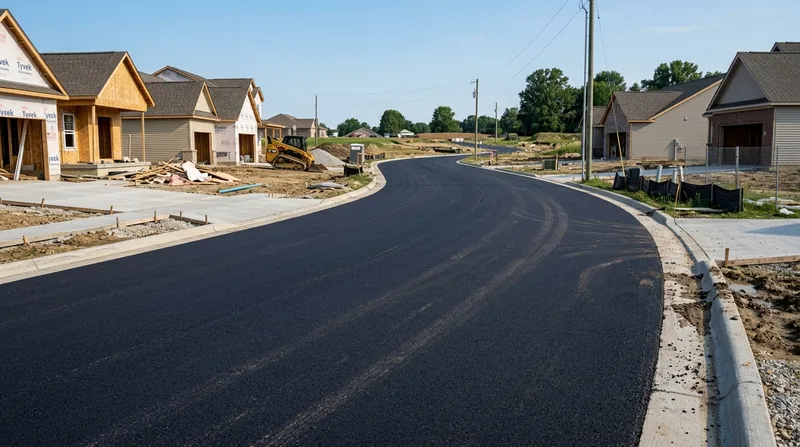




Private Road & HOA Paving in Lafayette means building subdivision streets and common-access lanes that stand up to central Indiana's freeze-thaw cycle and the heavy traffic of residential communities. Lafayette sits on a clay-rich glacial till plain where winter water heaves thin bases and breaks poorly-built roads by spring. Across Tippecanoe County's growing subdivisions, from the Wabash River lowlands to the rolling farmland edges, private roads carry the full load of HOA traffic and equipment without the municipal maintenance budget. We build thick aggregate bases and pave multi-course asphalt sized for the frost depth and the traffic load your road will see, with written estimates that specify tonnage and thickness so you know exactly what you're getting.
Why Private Road & HOA Paving Fails in Lafayette: Understanding the Frost and the Fix
Central Indiana winters work on asphalt from below. The freeze-thaw cycle heaves slabs, opens alligator cracking, and turns a weak base into a failed road in two or three seasons. Most private roads in Lafayette subdivisions were built with a thin base or no base at all, laid directly on subgrade that won't drain on its own. When spring melt and summer rain soak that clay-rich till, the road loses support, and the asphalt cracks and ruts under the weight it was never designed to carry.
- We remove the failed asphalt and any inadequate base material down to solid subgrade.
- We compact a thick aggregate base, sized for the frost depth your road will see in a central Indiana winter.
- We pave a binder course and a surface course, built for the traffic load and the freeze-thaw cycle.
- We specify tonnage and compaction in writing so you know the road was built to last, not just patched over a failed base.
A private road built this way will carry HOA traffic and the occasional heavy equipment without failure for fifteen to twenty years, and the math works because you're paying once for a real base instead of twice for patches.
Key info: Many subdivisions in Lafayette and West Lafayette have private roads that were never designed for the traffic they carry. If your HOA road is rutting, cracking, or breaking at the edges, the base has likely failed, and an overlay will not hold. A full-depth rebuild is the only fix that lasts.
For more on what happens when a base fails and what it costs to put it right, see our guide to asphalt resurfacing and overlay, which covers the repair-versus-replacement decision in detail.
How We Build a Private Road in Lafayette: From Subgrade to Finished Asphalt
A private road is built in stages, each one checked and compacted before the next begins. We start with a site visit to measure the road, assess the subgrade, and understand the drainage and frost depth. From there, we pull any failed asphalt, grade and compact the base, and pave the road in two or three courses depending on traffic load and the thickness your road requires.
- We measure the road length, width, and existing surface condition, and we verify the local permitting requirements with your HOA and the municipality.
- We remove the failed asphalt and any weak base material, and we proof-roll the subgrade to confirm it is solid before we build on it.
- We grade and compact the aggregate base to the thickness and density required for your road's frost depth and traffic load.
- We pave the binder course and surface course, compacting each layer hot and to specification.
- We provide a written record of tonnage, thickness, and compaction so your HOA has proof of the work.
The whole process takes two to four weeks depending on road length and weather, and the road is open to light traffic within 24 to 48 hours of paving, though full cure takes several weeks.
Local example: A one-half-mile private road in a Shadeland or Battle Ground subdivision typically runs 24 to 28 feet wide and carries 30 to 50 vehicle trips per day. We build a 6-inch aggregate base and a 3-inch hot mix surface, paving it in two weeks and opening it to traffic within days. The written estimate specifies tonnage (roughly 180 to 220 tons) so the HOA knows exactly what is being installed.
For a detailed look at the base preparation and grading work that comes before paving, see our page on gravel driveway installation and grading, which covers subgrade assessment and compaction in depth.
Private Road & HOA Paving Methods
| Approach | Description | Best for |
|---|---|---|
| Full-Depth Replacement | Remove all failed asphalt and weak base, compact new aggregate base, pave binder and surface courses to specification. | Roads with failed bases, alligator cracking, severe rutting, or roads built without adequate base material. |
| Overlay (Mill & Pave) | Mill the top 1.5 to 2 inches of worn asphalt, compact the base below, and pave a new surface course. | Roads with sound bases, surface wear, and minor cracking, where the base has not failed. |
| Recycled Asphalt Millings Base | Compact recycled asphalt (RAP) to build or restore the base layer, then pave hot mix surface on top. | Budget-conscious HOAs, roads with thin or missing bases where full new aggregate is not available. |
| Tar & Chip (Chip Seal) | Spray a thin layer of liquid asphalt and roll in stone chips to bind them, creating a low-cost surface. | Low-traffic private roads, rural lanes, temporary surfaces, or roads where HOA budget is very tight. |
Each method has a cost and a lifespan. Full-depth replacement is the most expensive and lasts 15 to 20 years. Overlay is less expensive but only works if the base is sound. Recycled millings and tar & chip are budget options for lower-traffic roads but require more frequent maintenance. We recommend the method that matches your road's condition and your HOA's long-term budget.
Private Road & HOA Paving Cost in Lafayette: What to Expect
A private road in Lafayette starts at $15,000 for a short quarter-mile lane with a sound base needing only an overlay. A full-depth replacement of a half-mile road in a typical subdivision costs $25,000 to $45,000 depending on base thickness, traffic load, and the cost of aggregate and fuel in the current market. An HOA road that is a full mile long with a failed base can run $50,000 to $80,000 or more. The single biggest cost driver is whether the base must be rebuilt or can be reused, and the second is road length and width.
Other factors that affect cost include the condition of the existing asphalt (how much must be removed and hauled away), the compaction and proof-rolling required to confirm the subgrade is solid, the thickness of the base and surface courses (which depend on frost depth and traffic load), and whether the road has drainage issues that need grading or culvert work. We provide a written estimate that breaks down tonnage, thickness, and the work required, so you see exactly where the cost comes from.
Get a full pricing overview for all our services, and call us at (765) 523-8939 for a free on-site estimate. We respond within 24 hours and will walk your HOA through the options and the cost of each one.
Hiring an Asphalt Paving Contractor Near Me in Lafayette: What to Ask and What to Verify
A private road is a large investment, and the contractor you choose makes the difference between a road that lasts and one that fails in a few years. When you're looking for an asphalt paving contractor near Lafayette, ask for written estimates that specify tonnage and thickness, check references from other HOAs and subdivisions, and verify that the contractor understands local permitting and HOA architectural standards. In Lafayette and West Lafayette, some municipalities require permits for road work; others do not. Your HOA may have its own design standards or material requirements. A good contractor will help you navigate those rules, not ignore them.
- Ask for a written estimate that includes road measurements, base thickness, surface course thickness, tonnage of asphalt, and the compaction method.
- Check references from at least two other HOAs or private roads the contractor has paved in the past three years.
- Verify that the contractor is fully insured and ask to see a certificate of insurance before work begins.
- Ask the contractor to confirm local permitting requirements with your municipality and HOA before providing the estimate.
- Get at least two estimates so you can compare methods, cost, and timeline.
Avoid contractors who offer unsolicited door-to-door quotes, demand a large cash deposit before starting, or quote a price that seems too good to be true. The honest way to verify any contractor is to ask for specifics (tonnage, thickness, compaction), check their insurance and references, and confirm they understand your local rules.
Ready to move forward? Contact us for a free estimate. We've been paving private roads and HOA streets in Lafayette and Tippecanoe County since 2009, and we'll give you a clear, written breakdown of the work and the cost.
Private Road & HOA Paving in Lafayette: Pricing Guide
| Service | Price | Details |
|---|---|---|
| Short overlay (quarter-mile, sound base) | Starting at $15,000 | Mill and pave a quarter-mile road with a solid base needing only surface refresh |
| Full-depth rebuild (half-mile private road) | $25,000 to $45,000 | Remove failed asphalt, rebuild aggregate base, pave binder and surface courses for typical subdivision |
| Full-mile private road with failed base | $50,000 to $80,000+ | Complete removal, base replacement, paving, and grading for longer roads in growing subdivisions |
| Complex or specialty scope | On estimate | Drainage work, utility relocation, culvert repair, or roads with unusual terrain require on-site assessment |
| Travel and mobilization | Included | No extra charge for work in Lafayette, West Lafayette, and surrounding Tippecanoe County areas |
| Free estimate | No obligation | Written measurements and cost breakdown within 24 hours, call (765) 523-8939 to schedule |
Indicative pricing, the exact cost depends on square footage, finish, and site access. Free personalized estimate within 24h at (765) 523-8939.


