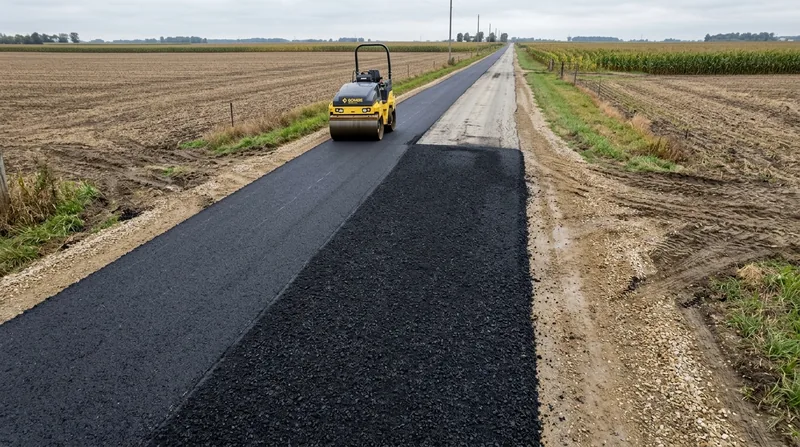




Recycled asphalt and millings driveways are a practical, budget-conscious surface option for farm lanes, acreage properties, and rural drives across Warren, Montgomery, Fountain, Clinton and Carroll counties surrounding Lafayette. The clay-rich glacial till that underlies Greater Lafayette holds water and demands a surface that sheds it; recycled millings compact into a stable, permeable layer that works on that subgrade without the full cost of hot mix asphalt. Whether you own a long gravel lane leading to a farmhouse in Attica or Monticello, or manage a private road serving multiple properties in the rolling country outside Battle Ground or Buck Creek, recycled asphalt millings offer a middle ground between bare gravel and new paving. We grade the base, compact the millings, and build a surface that handles seasonal thaw and farm traffic alike. Since 2009, we have installed and maintained millings drives across the region, working with the clay subsoil that every contractor in central Indiana knows will heave and crack if water sits on it.
Why Recycled Asphalt Millings Make Sense for Rural Lafayette-Area Properties
Recycled asphalt millings are the reclaimed, compacted fines from milling old asphalt pavements. They contain binding agents that help them lock together under traffic and compaction, unlike virgin crushed stone or pit-run gravel. On the clay till that dominates Warren and Montgomery counties, a properly graded and compacted millings surface sheds water off the top while the base prep underneath handles subsurface drainage. The cost is significantly lower than new hot mix asphalt, and the material is reused rather than sent to landfill.
- We grade and compact the clay base to shed water away from the drive and toward the shoulders.
- We spread recycled asphalt millings to a specified depth, typically 3 to 4 inches for a residential or light-traffic farm lane.
- We proof-roll the compacted surface to verify density and stability before you use the drive.
- The millings lock together under traffic and seasonal freeze-thaw cycles, providing years of stable riding surface.
- Maintenance involves raking and adding fresh millings every 2 to 3 years as surface fines wash away.
A millings drive does not require the same base thickness or engineering as a full asphalt pavement, making it ideal for budget-conscious property owners who want a step up from loose gravel.
Key info: Farm properties in Attica, Monticello, and the unincorporated areas of Warren County often lack municipal sewer and water infrastructure. Recycled millings driveways fit that rural context because they are lower cost upfront and do not require the same permitting or subgrade engineering as full-depth asphalt replacement.
How We Install Recycled Asphalt Millings Driveways in Lafayette and Surrounding Counties
Installation of a recycled millings drive begins with a site walk to assess the existing base, drainage, and traffic load. We clear the surface, grade to establish proper slope away from structures and toward the shoulders, and compact the clay subgrade. We then spread and compact the recycled asphalt millings in lifts, proof-rolling to confirm density. The entire process takes one to three days depending on drive length and existing conditions.
- We inspect the existing drive and identify any soft spots, standing water, or drainage problems that must be addressed first.
- We clear vegetation and debris, then grade the subgrade to a 2 to 3 percent cross-slope so water runs off to the sides.
- We compact the base clay and add a gravel layer if the subgrade is too soft to hold the millings without rutting.
- We spread recycled asphalt millings in one or two lifts, compacting each with a vibratory roller to lock the fines together.
- We proof-roll the finished surface under loaded equipment to verify it will not rut under your normal traffic.
The finished surface is ready to drive on immediately, though the millings will continue to compact slightly over the first few weeks under traffic.
Local example: A quarter-mile farm lane serving two houses near Shadeland with a soft, rutted clay base required regrading and a 4-inch millings lift. We compacted it to 95 percent density, and it has held stable through three winters of freeze-thaw cycles and farm truck traffic without significant rut or washboard.
For comparison, our approach to gravel driveway installation and grading uses similar site prep and compaction techniques, but recycled millings offer better binding and longevity than virgin crushed stone on clay subgrades.
Recycled Asphalt Millings Driveways: Methods and Material Options
| Approach | Description | Best for |
|---|---|---|
| Recycled Asphalt Millings (RAP) | Reclaimed fines from milling old asphalt, compacted to 3 to 4 inches over prepared subgrade. | Farm lanes, rural acreage drives, and light-traffic private roads where budget is a priority and the subgrade is stable. |
| Millings with Gravel Base | Recycled asphalt millings placed over a 4 to 6 inch compacted gravel or crushed stone base layer. | Soft clay subgrades or areas with high seasonal water that need extra drainage and load distribution. |
| Raking and Top-Up | Maintenance of an existing millings drive by raking the surface, filling ruts, and adding fresh material. | Established millings drives that have settled or lost fines to weather after 2 to 3 years of use. |
| Millings Over Existing Asphalt | Recycled asphalt millings spread and compacted over a failing asphalt surface as a temporary or budget renewal. | Old, broken asphalt drives where a full asphalt resurfacing or overlay is not yet justified. |
Recycled Asphalt and Millings Driveways Cost in Lafayette: What to Expect
Recycled asphalt millings driveways in Lafayette and the surrounding counties start at approximately $3 per square foot for base grading, compaction, and millings installation on a stable subgrade. A 500-square-foot farm lane apron or short driveway would run $1,500 to $2,000 before any additional base work. A longer quarter-mile drive serving multiple properties may cost $4,000 to $8,000 depending on base condition, drainage needs, and whether gravel or additional compacted stone is required underneath the millings.
Cost factors include the current condition of the subgrade (soft clay or standing water requires more grading and base prep), the length and width of the drive, whether utilities or culverts must be respected, and local permitting if the drive crosses a municipal right-of-way or affects stormwater runoff. We provide a written estimate with tonnage specifications, so you know exactly what material is going down and what the labor and equipment cost. Visit our pricing page for a full breakdown of how we quote millings and gravel work.
Getting two or three estimates from local contractors is standard practice. Each estimate should specify the depth of millings, the base preparation required, and the compaction method. A price that seems too low often means the contractor is skipping base prep or using virgin stone instead of recycled asphalt, both of which lead to rutting and washboard within a season or two.
Recycled Asphalt and Millings Driveways Near Me: What Lafayette Homeowners and Property Managers Should Know
Hiring a contractor for recycled asphalt millings work requires the same care as hiring for any paving project. Start by asking whether the contractor is fully insured and can provide a certificate of insurance on request. In Lafayette and West Lafayette, permitting rules for driveway work vary by jurisdiction; your contractor should help you understand whether a permit is required for grading or apron work by checking with your local building department. If you own property in an HOA-governed subdivision, check your architectural guidelines to confirm that a recycled millings surface is permitted (some HOAs require asphalt or concrete only).
- Get a written estimate that specifies the depth of millings, the base preparation, and the compaction method, not just a per-square-foot price.
- Ask the contractor for references from similar jobs on rural or farm properties, and call at least two to ask about durability and maintenance.
- Verify that the contractor has local equipment on site and is not a traveling crew with out-of-state plates offering a one-time deal.
- Confirm that your property does not require a permit for driveway work by calling your municipal building department or county planning office.
- Ask whether the contractor handles Indiana 811 utility locates before any excavation, as grading and base prep may disturb buried lines.
- Understand the maintenance plan: recycled millings drives need raking and top-up material every 2 to 3 years to maintain surface quality.
A honest contractor will explain when a millings drive is the right choice and when your property would benefit more from full asphalt driveway paving or a tar and chip surface. We are happy to discuss your options at (765) 523-8939 or via our contact page, with a free estimate and no obligation to book.
Recycled Asphalt & Millings Driveways in Lafayette: Pricing Guide
| Service | Price | Details |
|---|---|---|
| Recycled Asphalt Millings (RAP) Installation | Starting at $3/sq ft | Includes base grading, compaction, and 3 to 4 inch millings lift on stable subgrade with proper drainage slope. |
| Millings with Gravel or Stone Base | Starting at $4.50/sq ft | Adds 4 to 6 inches of compacted gravel or crushed stone beneath millings for soft clay or high-water conditions. |
| Maintenance: Raking and Top-Up | Starting at $1.50/sq ft | Refreshes existing millings drive by raking, filling ruts, and adding fresh material after 2 to 3 years of use. |
| Complex Base Prep or Drainage Work | On estimate | Soft subgrade, standing water, culverts, or utilities require site assessment before pricing can be firm. |
| Travel and Estimate | Included / Free | No mileage charge in Lafayette and surrounding counties. Free written estimate within 24 hours, no obligation. |
Indicative pricing, the exact cost depends on square footage, finish, and site access. Free personalized estimate within 24h at (765) 523-8939.


